This is what your player's swing report looks like.
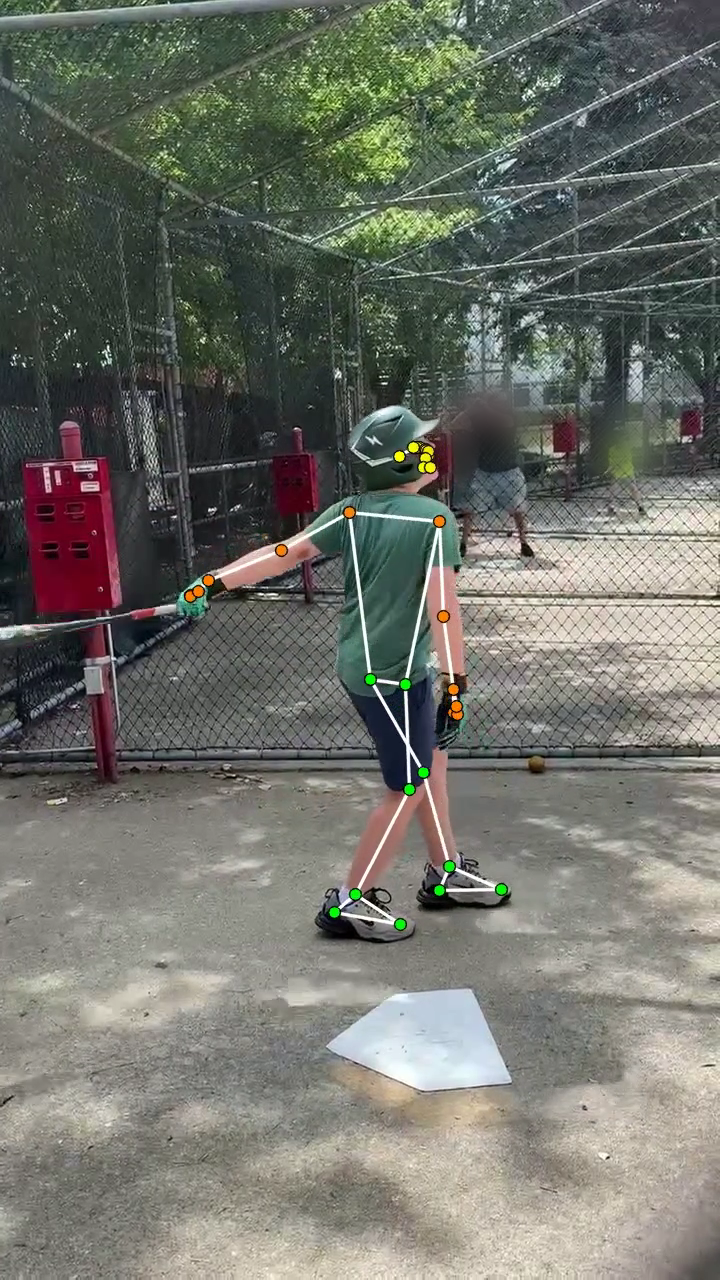
One 5-second phone video, filmed through the fence of a batting cage. Angular Baseball returned everything on this page — the score, the strengths, the fixes, and the drills. Nothing below has been edited.
The coach's read
"John, your swing scores 78/100 — a solid foundation with real power potential. Your hip-first rotation (49°) and active back-leg drive (121°) show you understand how to generate force, but you're losing that power at the last moment by falling back instead of driving through the ball."
"Your lower body is doing exactly what it should. That 121° back-knee bend keeps your engine running through contact, and your front leg braces at 172° — nearly perfect — giving you a rock-solid post to rotate against. You've built the power engine; now we just need to transfer it."
"This week, let's fix two things that are costing you hard contact: your trunk is leaning back (-5°) when it should be driving forward (+5° to +15°), and your back elbow is too extended (133°) at contact. When you fall back and cast your arm early, the barrel takes a long, loopy path — that's why you're popping up and struggling with velocity inside. Watch a video of Juan Soto or Kyle Schwarber: their weight drives forward INTO the ball while their elbows stay tight. That's the move."
"You've got the athletic ability and the hip rotation to be a dangerous hitter — you just need to stay through the ball instead of away from it. Stick with the front-foot plant drill, and you'll see line drives instead of fly balls."
What's working
Three mechanics measured in the elite range. Real numbers, not encouragement — the angles are read off the pose track at contact.
Hip-first rotation
The hips lead the shoulders into contact — the correct kinetic-chain sequence and the engine of power.
Active back-leg drive
The back knee stays bent and driving through the ball — good lower-body engagement.
Firm front-leg brace
The front leg braces firm and straight at contact (150–175° is the benchmark), giving the rotation a rigid post to drive against — exactly what transfers power into the ball.
What to fix first
Each issue comes with the measured value, the elite benchmark, and a specific drill — not "work on your mechanics."
Falling back at contact
The trunk is leaning backward at contact — weight is shifting onto the back foot instead of driving forward into the pitch. This causes pop-ups, weak pull-side contact, and trouble hitting anything away.
Drill: Front Foot Strike and Plant · 3 sets of 10
- Put a piece of tape where your front foot lands after your stride
- Your front foot must STRIKE the tape hard and stay planted through contact
- If you fall backward, your front foot will lift or roll — instant feedback
- Cue: "Stomp and stay"
- Film from the side — watch for forward lean at contact, not backward drift
Lead shoulder rotation off
The lead shoulder travels either too little (the front side pulls off early / flies open before the hands reach contact) or too much (over-rotating into a long, loopy swing). Elite hitters rotate fully but stay compact — about 100–145° of lead-shoulder travel.
Drill: Fence Drill · 3 sets of 10
- Stand facing a fence or wall, toes 6–8 inches away
- Take your normal stride and swing
- If your front shoulder opens early, the bat will clip the fence
- Focus on keeping the front shoulder in and driving through the ball
- The fence gives instant physical feedback
Arm casting
The back elbow is too extended at contact. When the arms extend this early the barrel takes a long, loopy path to the ball, making it hard to catch up to velocity and reducing coverage on inside pitches.
Drill: Inside Tee + Towel Drill · 3 sets of 10
- Place a tee on the inside corner at mid-thigh height
- Tuck a small towel under your back armpit — hold it lightly
- Take your normal stance with slight knee bend
- Start the swing keeping your back elbow pinned to your side
- The towel must stay tucked until your hands pass your front hip
- Only then extend and drive through the ball
- Ball should go hard to the pull-side gap — not popped foul
The swing, phase by phase
The whole swing takes under three-quarters of a second. The report breaks it into five phases and tells you where it holds up and where it leaks.
Setup
Ready and balanced, feet shoulder-width apart.
Load
Hips coil nicely, loading rotation and energy.
Stride
Front foot plants firm (172° brace), but trunk starting to tilt back here.
Contact
Trunk at −5° (falling back), back elbow over-extended at 133°, hip-shoulder separation solid at 49°.
Follow-through
Limited forward drive due to backward lean; finish is compromised by early arm extension.
This week's focus
Every report ends with one priority — the single change that unlocks the most, with exactly how to practice it.
Front Foot Strike and Plant
Stops the weight from crashing backward at contact.
- Put a piece of tape where your front foot lands after your stride
- Your front foot must STRIKE the tape hard and stay planted through contact
- If you fall backward, your front foot will lift or roll — instant feedback
- Cue: "Stomp and stay"
- Film from the side — watch for forward lean at contact, not backward drift
What this page is: a real report, generated by the app from a real swing on a real account — we just dropped it into a web page. Every number was measured from the video; none of the text was rewritten. Reports also include the full annotated slow-motion video and progress tracking across swings, which don't fit on a static page.
Get this for your player's swing.
Film 5 seconds on your phone. Get the full report in about 30 seconds. Free to try — no sensors, no tripods, just your iPhone.
Download on theApp Store