Freddie Freeman's Swing: Staying Through the Ball
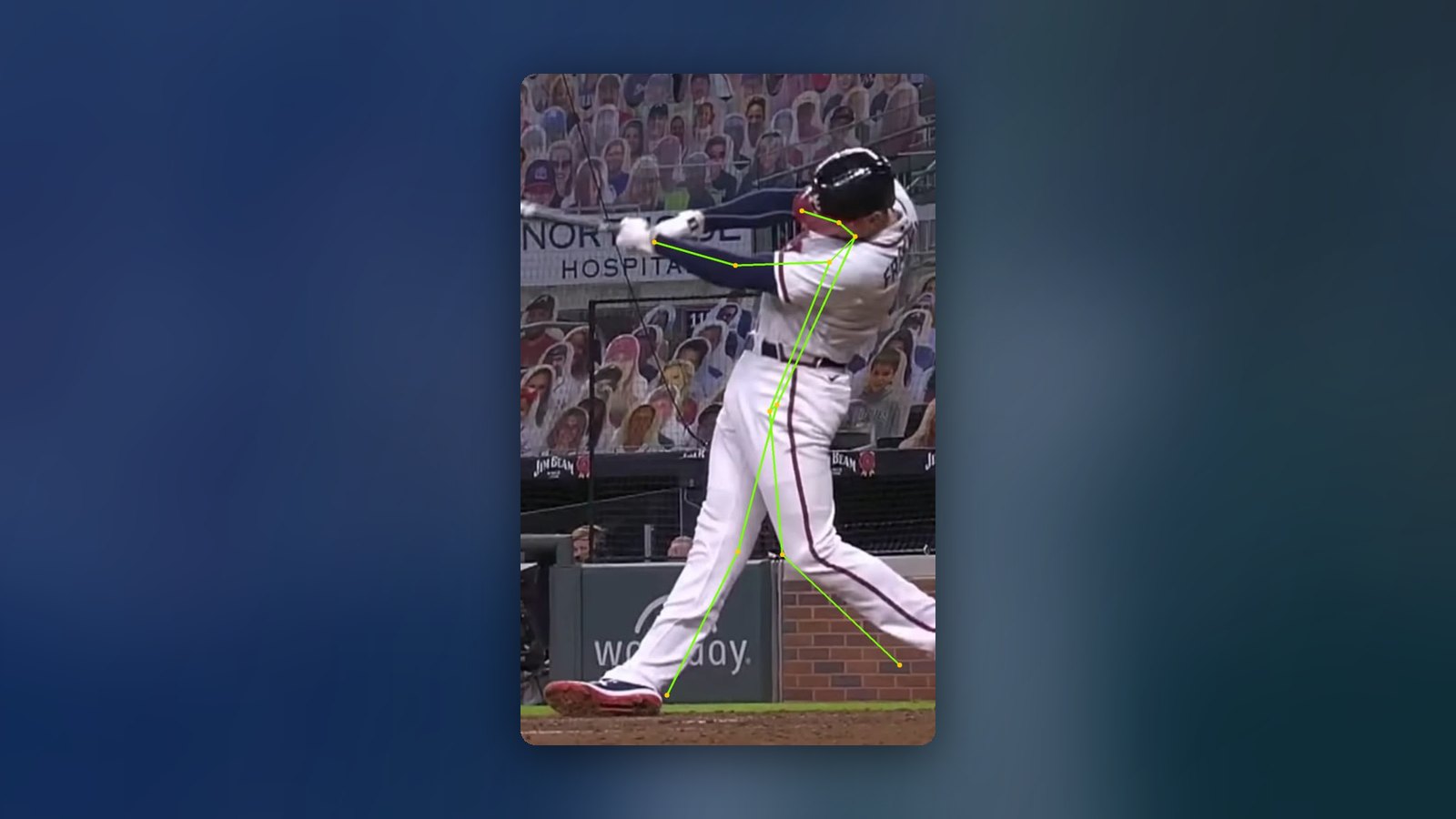
If you wanted to teach a swing from a textbook, you'd use this one. Freeman is our reference for the quality that holds everything else together: balance. And of every number we pull out of a swing, this is the one where the gap between a big-league hitter and a typical youth swing is widest — about 40 degrees wide.
What he's known for
Smooth, repeatable, and almost impossible to knock off balance. Freeman gets his chest out over the plate and stays through the ball instead of pulling off it — which is why he drives an outside pitch the other way as easily as he turns on an inside fastball. There's no lunging and no falling back. The same posture shows up swing after swing, season after season.
His 2024 World Series is the argument for repeatability: a walk-off grand slam in Game 1 — the first in World Series history — and a home run in each of the first four games, on the biggest stage there is, with the same swing he'd been taking in April.
The mechanic: forward trunk lean
Trunk lean is the tilt of the torso at contact, measured from vertical. Positive means the chest is tipped toward the pitcher. Negative means the hitter is leaning back toward the catcher.
Getting the chest forward over a braced front leg does three things at once:
- It finishes the weight transfer. Energy built in the legs and hips arrives at the ball instead of dying in the back hip.
- It puts the barrel on plane with the pitch. A pitch travels slightly downhill; a hitter leaned back has to swing uphill to meet it, and the margin for error shrinks.
- It buys plate coverage. Chest over the plate means the barrel can still reach the outer third. Leaning back, the outside corner is simply out of range, which is why a "pull-only" hitter is often really a balance problem.
Falling back is the most common balance fault we see, and it's usually the hidden cause behind the two complaints parents actually bring us: weak pop-ups and rolling over on everything away.
What Angular measured
Through the same pipeline your swing runs through, Freeman reads 23° of forward trunk lean at contact — chest tipped toward the pitcher, weight centered over a braced front side.
Now the comparison that made us rebuild how we coach this check:
| Trunk lean at contact (+ = toward the pitcher) | Reading |
|---|---|
| Freddie Freeman (our clip) | +23° |
| Shohei Ohtani (our clip) | +26° |
| Target band for a scored youth swing | +5° to +15° |
| Youth swings in our benchmark set (median) | −17° |
| Youth swings in our benchmark set (range) | −24° to −5° |
Read that youth row again: the median isn't a small positive number, it's negative seventeen. And the whole range is negative — every youth swing in that set was leaning away from the pitcher at the moment of contact. Not one of them was over the ball. That is a roughly 40-degree gap between a big-league first baseman and the middle of a youth tee session, on a mechanic that costs nothing to train.
How to spot falling back on your kid's video
Film from the side, belt height, whole body in frame. Pause on the frame where the bat meets the ball, then draw an imaginary line from the front shoulder straight down.
- Where does that line land? Over the front foot or ahead of it: good. Behind the belt buckle, back toward the rear foot: the hitter is falling back.
- Watch the head. If the head travels backward from load to contact, weight is going the wrong way. A good swing's head moves slightly forward, then stays still.
- Watch the front foot after contact. Falling back makes the front foot lift, spin, or roll onto its outside edge. Planted and quiet means the weight got where it was going.
- Check the ball flight. Lazy fly balls to the pull side and weak grounders on outside pitches are the two signatures.
The fix: Front Foot Strike and Plant
This is the drill our app assigns when trunk lean comes back negative. It's the rare one that gives its own feedback — you don't need a coach watching to know whether the rep was good.
Front Foot Strike and Plant
- Put a piece of tape on the ground where the front foot lands after a normal stride.
- The front foot must strike the tape hard and stay planted through contact.
- If the hitter falls backward, the front foot lifts or rolls — instant, honest feedback.
- Cue: "Stomp and stay."
- Film from the side and check for forward lean at contact, not backward drift.
What a good rep looks like: the front foot lands, the front leg firms up and straightens toward 150–175°, and the chest continues out over it. The finish should feel like the hitter is standing on the front leg, not sitting behind it. Line drives, and outside pitches that go to the opposite-field gap instead of dribbling to short.
Age note. If a 10–12-year-old can't hold the plant, the problem is often front-side strength, not intent. Reduce the stride length until they can hold it, then grow it back. And check the coaching cue they've been given: "stay back" is the single most over-applied instruction in youth hitting, and a kid who has taken it literally will keep producing exactly this number no matter how many swings they take.
Want to know which way your hitter is leaning? Film one swing from the side and run it through Angular Baseball — trunk lean comes back as a number on the contact frame, so you can stop debating it. First analysis is free.