Shohei Ohtani's Swing: What 56° of Separation Looks Like
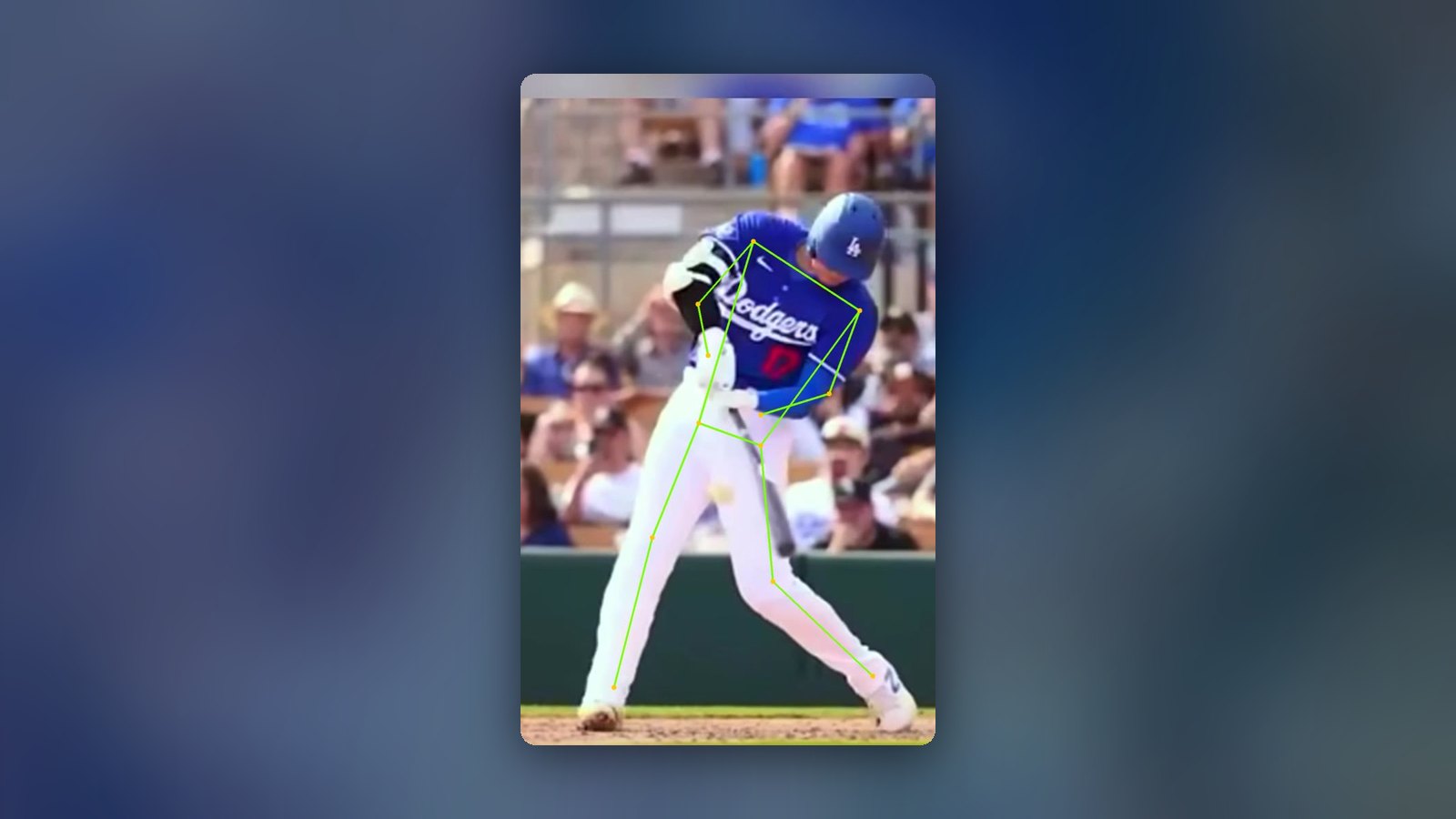
Ohtani is the most complete athlete in baseball and the most violent rotation we've put through our model. Four unanimous MVPs, the first 50-homer/50-steal season anyone has ever had, and — for our purposes — the swing we point at when we need to show a young hitter what stored torque looks like.
What he's known for
Effortless, all-fields power that plays in any count. Watch him in slow motion and the thing that stands out is how unhurried it looks for a ball that leaves at 115 mph. He gets to his back side, then unwinds — the hips open toward the pitcher while the shoulders stay closed for a beat longer, loading the torso like a spring being wound.
That stored tension is what turns a smooth-looking swing into a 450-foot home run. It's leverage, not muscle. Which is exactly why it's the first thing we teach: leverage is available to a 90-pound twelve-year-old. Muscle isn't, yet.
The mechanic: hip-shoulder separation
Separation is the angle between the line of your hips and the line of your shoulders, viewed from above, at the moment it's largest — usually just after the front foot lands and just before the shoulders start to turn. Coaches call it the X-factor. Kids call it "the twist."
Here's the plain-English version. Your swing is a chain: ground → legs → hips → torso → shoulders → arms → bat. Each link accelerates the next. If every link fires at the same instant, the chain doesn't multiply anything — you get one shove, delivered mostly by the arms. If the links fire in order, each one whips the next, and the bat arrives with speed nobody in the chain generated on their own.
Separation is the visible evidence that the chain is firing in order. Hips first, shoulders late. The gap between them is stored energy waiting to be released.
The published research puts elite hitters and pitchers somewhere around 30 to 55 degrees of peak separation, with Driveline putting "elite" near 48°. The exact number is individual — it depends on torso length and how much slack a body has to pull out. What's not individual is the sequence.
What Angular measured
We ran Ohtani's swing through the same pipeline your swing goes through — same pose model, same joint-angle math, same contact detection, no special treatment. He peaks at 56° of hip-shoulder separation, at the top of the elite band and the most of any active hitter in our eight-swing reference set. The only clip that reads higher is Barry Bonds, at 60°.
| Peak hip-shoulder separation | Reading |
|---|---|
| Barry Bonds (our clip) | 60° |
| Shohei Ohtani (our clip) | 56° |
| Ronald Acuña Jr. (our clip) | 40° |
| Our target band for a scored swing | 30–55° |
| Youth swings in our benchmark set | 12–83° |
That last row is the interesting one. Youth separation isn't uniformly low — it's uniformly unpredictable. A 70-degree spread across the same age group means roughly half of those kids are storing real torque and the other half are either firing everything at once (down at 12–20°) or spinning through so far past the coil that the stored energy leaks before contact (up at 80°+). Both look like "swinging hard" from the third-base coaching box. They score very differently.
How to spot it on your kid's video
You don't need our app to run this check. Film one swing from the side, at belt height, whole body in frame. Then scrub to the frame where the front foot has just landed flat and stop.
- Look at the belt buckle. It should already be starting to turn toward the pitcher.
- Look at the front shoulder. It should still be pointed at the plate — closed, not yet turning.
- That difference is the separation. If the buckle and the shoulder are pointed the same direction in that frame, there is none. The hitter is turning as one block.
The other tell is the sound. A swing with no separation is arms-only, and arms-only swings are quiet — a lot of visible effort, an unimpressive noise off the bat, and a ball that dies at the warning track when it should have carried.
Why young hitters lose it
Almost never because they can't do it. Two causes, both coachable:
- The cue "swing hard" is interpreted as "turn everything now." A kid told to be aggressive will rotate the shoulders on the first frame, because that's where they feel strong. The hips have nothing left to lead with.
- No stride, or a late stride. Separation is created during the stride — the front foot going down is what lets the lower half get ahead of the upper half. A hitter who lands late has run out of runway to build any.
The fix: the Hip Fire Drill
This is the exact drill our app hands you when separation is your biggest gap. All you need is a light resistance band.
Hip Fire Drill
- Anchor a light resistance band at hip height behind home plate.
- Hold the ends at your waist in your normal stance.
- Begin your swing by rotating only your hips toward the pitcher.
- Keep your front shoulder closed as long as you possibly can.
- When your hips are nearly facing the pitcher, then fire the shoulders.
- The band resists early shoulder rotation — you'll feel where the separation lives.
- Five slow-motion reps first, then five at full speed.
What a good rep feels like: a stretch across the front of the ribcage and the oblique on the back side, right at the moment before the shoulders go. Kids describe it as "rubber-banding." If a rep feels like nothing, the shoulders left early — slow it down until the stretch shows up, then add speed.
Age note. For 10–12s, keep it slow and unloaded; the goal is the feeling of the hips leading, not force. Piling resistance on a young hitter who doesn't have the sequence yet just teaches them to muscle through it faster. High schoolers can add tension and volume once the order is automatic.
Want the number instead of the guess? Film one swing from the side and run it through Angular Baseball — you'll get your hitter's peak separation measured against the same band Ohtani's swing sits in, plus whichever gap is costing them the most right now. First analysis is free.