How We Score a Baseball Swing, and What the Number Means
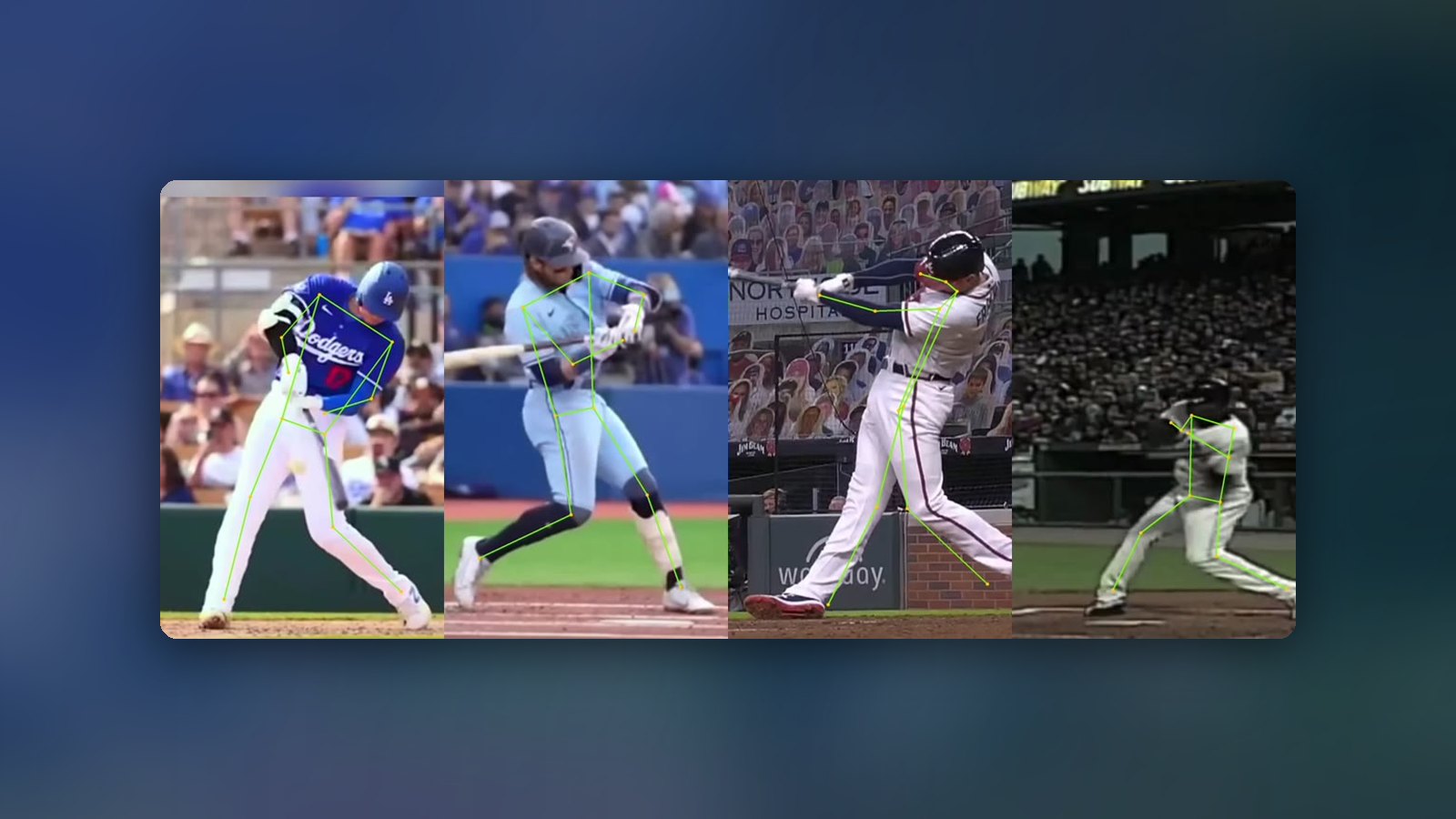
A swing score is worthless if it's just a vibe with a number attached. So before we shipped one, we had to answer a harder question than "is this swing good?" — we had to answer "good compared to what?" Here's how we built the reference, what the 13 checks actually measure, and the parts we still can't see.
The problem with the word "good"
Ask five hitting coaches to grade the same swing and you'll get five answers, all defensible. One is watching the hands. One is watching the front foot. One coached in a program where everybody hit off a high tee, so that's the lens. None of them are wrong — they just don't share a scale, which is why a kid can get told to "stay back" by one coach in March and "get out over it" by another in June.
Video didn't fix this. Filming your kid's swing on a phone gives you a thing to argue about, not a measurement. What was missing was a fixed reference: a set of numbers that mean the same thing in every dugout, on every field, in April and in August.
So we went and built one, out of the swings nobody argues about.
Step 1 — start with the film
We started where every hitting coach starts: with slow-motion video of elite swings, from the side-on angle our pose tracking reads best. Our reference set is eight big-league swings — Shohei Ohtani, Barry Bonds, Freddie Freeman, Bo Bichette, Ronald Acuña Jr., Mookie Betts, Bobby Witt Jr. and Yordan Alvarez — chosen because between them they cover the full range of ways a swing can be great. Not a highlight reel. A reference library.
Step 2 — nobody is elite at everything
This is the insight that shaped the whole system. Even the greatest hitters aren't the best at every part of the swing. Each one has a signature — the thing their body does better than nearly anyone else's. Bonds' path to the ball is not Bichette's path to the ball, and both are excellent.
So instead of copying one swing wholesale and grading everyone against it, we broke the swing into measurable components and learned each component from the hitter who owns it:
- Shohei Ohtani — hip-shoulder separation. His hips fire open while his shoulders stay loaded, storing torque like a wound spring.
- Barry Bonds — a connected, compact barrel. Nothing wasted between load and contact. The benchmark for short-to-the-ball.
- Freddie Freeman — staying through the ball. Chest out over a braced front leg, the same posture every single swing.
- Bo Bichette — hand speed and intent. A swing built to get the barrel to the ball in a hurry.
Each of those hitters gets a full breakdown in this series, including the drill that trains their signature.
Step 3 — run the pros through your pipeline
This is the part that makes the score trustworthy, and it's the part most "AI swing analysis" never does. We didn't hand-annotate the pro swings or eyeball them. We pushed those MLB clips through the exact same code path a swing filmed on your phone goes through: the same pose landmarker finding 33 body points per frame, the same joint-angle math, the same contact detection. No special treatment, no manual cleanup.
That matters because a measurement is only comparable to another measurement taken the same way. If we graded the pros with a ruler and your kid with an algorithm, the comparison would be theater. Running both through one pipeline is what turns "elite" from an adjective into a range of numbers.
Step 4 — the 13 checks
Every swing gets graded on the same 13 checks, spread across the five phases of the swing. Each has a target band; you're either in it, near it, or outside it. Here's the whole rubric, in the open:
| Phase | Check | Target | What it tells you |
|---|---|---|---|
| Setup | Stance & balance | 85–100% | Whether the video itself is clean enough to trust |
| Setup | Knee flex | 140–160° | Standing tall shuts the hips off before you start |
| Setup | Stance width | Shoulder width+ | A narrow base leaves no room to transfer weight |
| Load | Back knee stability | 130–150° | Holding the angle keeps weight loaded over the back leg |
| Stride | Timing vs. launch | ±80 ms | Front foot down on time, or fighting the pitch |
| Stride | Forward move | 7–15% of height | Momentum toward the pitcher, not spinning in place |
| Contact | Trunk lean | +5° to +15° | Driving through the ball vs. falling back |
| Contact | Back elbow angle | 90–120° | Connected barrel vs. casting |
| Contact | Hip-shoulder separation | 30–55° peak | The engine of rotational power |
| Contact | Front leg brace | 150–175° | A firm front side transfers energy into the ball |
| Contact | Lead shoulder rotation | 100–145° | Full rotation without flying open |
| Contact | Swing plane | +8° to +18° | Slightly up, matching the plane of the pitch |
| Follow | Hand speed | 5.0+ BL/s | Bat speed, measured relative to body size |
Two design decisions inside that table are worth calling out. First, the bands are ranges, not targets — there is no single correct number for a hitter's back elbow, and a system that pretends otherwise will flag good swings as broken. Second, hand speed is measured in body-lengths per second rather than raw pixels, so a 5'2" twelve-year-old filmed from ten feet away and a 6'2" high schooler filmed from twenty feet away can be compared honestly.
Step 5 — the score only adds
Here's the rule that governs how those 13 checks turn into one number: the score starts at zero and only earns points for things we can verify are good. Problems never subtract.
That sounds like a technicality. It isn't — it's the difference between a tool a 12-year-old uses again and one they delete. A subtractive score punishes a kid twice for the same flaw: once by pointing it out, and again by taking away a number they were proud of. Worse, it punishes them for things the camera got wrong. Under an additive score, a metric we can't confidently read simply earns nothing, and the report says so instead of quietly docking you.
Problems still get surfaced — prominently, ranked by how much they're costing you, each with a drill. They just live next to the score instead of inside it.
What we're honest about
Any company that tells you their phone-video model sees everything a $40,000 motion-capture lab sees is selling you something. Three real limits, in the open:
- One camera means two dimensions. We measure hip-shoulder separation from a single side-on view, so the number reads a little under true 3-D separation — the body foreshortens toward the lens. Our bands are calibrated to the 2-D reading, not borrowed from lab literature, which is why they're in the 30–55° range rather than the textbook 40–60°.
- Broadcast slow-motion breaks anything time-based. A TV clip played back at half speed halves every velocity in it. Speed and timing metrics are only comparable within the same kind of footage, so our reference values for those come from real-time phone video, not from the MLB clips.
- Film quality is a real input. Bad lighting, a bad angle, or a hitter half out of frame degrades pose detection, and the first check in the table exists to tell you when that has happened rather than let it silently corrupt everything downstream.
Step 6 — find the one thing to fix next
Scoring is the boring half. The useful half is what comes after: we line your numbers up against the elite bands, component by component, and find the biggest gap. Not all of them — the one. A 12-year-old handed six things to fix will fix zero of them.
That gap comes back in plain English ("your hips and shoulders are firing at the same time"), with a specific drill, sets and reps included. Then you film again in two weeks and the number tells you whether it worked. That loop — measure, fix one thing, re-measure — is the entire product. The score is just how you keep honest track of it.